
Table of Contents
ToggleDeck stairs are more than a means to get from point A to point B. They’re a functional element that shapes how people experience the entire outdoor space, setting the tone, framing the view, and dictating traffic flow. A poorly designed stair feels like an afterthought. A thoughtful one becomes the focal point.
Whether building new or replacing rotting stringers, the design decisions made now will affect usability, safety, and curb appeal for years. This guide walks through five major stair design categories, from classic straight runs to floating modern risers, plus creative ways to finish them with lighting and railings that actually work.
Key Takeaways
- Deck stair design significantly impacts functionality, safety, and curb appeal, with thoughtful stairs becoming a focal point rather than an afterthought.
- Code compliance requires riser heights no higher than 7¾ inches, minimum tread depth of 10 inches, and handrails for any stairway with four or more risers.
- Classic straight deck stairs are code-friendly and efficient, but L-shaped, wraparound, and wide cascading designs offer architectural interest and solve complex site conditions.
- Modern floating stairs with open risers create clean sightlines and contemporary aesthetics, though they require engineered plans and professional permits in most jurisdictions.
- Proper material selection—rot-resistant treated lumber, composite, or PVC—combined with good drainage and secure footings below the frost line ensures deck stairs last 30 years instead of 10.
- Railing style and low-voltage LED lighting transform stairs from purely functional elements into finished architectural features while maintaining safety and sightlines.
Why Deck Stairs Matter More Than You Think
Most deck failures start at the stairs. Stringers rot out first because they’re closest to grade and often lack proper flashing. Treads wear unevenly. Railings loosen. And if the original design didn’t account for how people actually move, carrying groceries, wrangling kids, hauling a cooler, the deck never quite works.
Beyond durability, stairs are a design lever. They can make a small deck feel grand with a wide cascading entry, or tuck discreetly to the side with an L-shaped run. They define where guests enter, how they pause, and what they see first.
Code compliance isn’t optional. The International Residential Code (IRC) mandates maximum riser height of 7¾ inches, minimum tread depth of 10 inches, and consistent dimensions within ⅜ inch throughout a flight. Handrails are required for any stairway with four or more risers. Local jurisdictions may be stricter. Pull a permit if the deck is attached to the house or exceeds 30 inches above grade in most areas.
Invest in rot-resistant materials, pressure-treated southern yellow pine rated for ground contact, cedar, composite, or PVC, and design drainage into every horizontal surface. Stairs done right outlast the deck itself.
Classic Straight Deck Stairs
Straight stairs are the workhorse. Single flight, center or side placement, predictable layout. They’re code-friendly, material-efficient, and buildable with a circular saw and speed square.
Standard construction uses three 2×12 stringers spanning from the deck rim joist to a concrete footing or gravel pad. Stringers should be spaced no more than 16 inches on center for composite treads, 12 inches for thinner PVC or painted wood. Use galvanized stringer brackets at the top and anchor the bottom to a treated 2×6 or 4×4 base plate set on compacted gravel and concrete piers.
Tread material drives aesthetics. 5/4×6 decking boards (actual 1 inch × 5½ inches) match the deck surface and install quickly. 2×6 dimensional lumber offers more mass and a traditional look. Composite treads eliminate seasonal movement but cost 2–3 times more.
Width matters. Code minimum is 36 inches clear between handrails, but 48 inches feels more generous and allows two people to pass. Go wider if the deck is elevated and stairs serve as the main entry, anything narrower than the door they’re leading to feels pinched.
For a cleaner look, recess stringer cuts slightly and use hidden fasteners or structural screws driven from below. Paint-grade stringers benefit from a construction tutorial on precise layout to avoid squeaks and uneven risers.
Wraparound and L-Shaped Stair Designs
L-shaped and wraparound stairs add architectural interest and solve tricky site conditions, steep slopes, tight corners, or decks with multiple entry points.
L-shaped stairs turn 90 degrees at a landing, breaking a long run into two shorter flights. Landings must be at least 36 inches deep in the direction of travel and as wide as the stair itself. Frame the landing like a mini deck: doubled joists, blocking every 16 inches, and the same decking as the main surface. The landing resets the stringer layout, so each flight can adjust to grade changes without weird riser math.
Wraparound designs follow the deck perimeter, often with stairs on two or three sides. They’re ideal for pool decks, elevated porches, or anywhere foot traffic comes from multiple directions. The visual effect softens the hard edge of a rectangular deck and invites exploration.
Construction tip: Each flight needs independent footings. Don’t cantilever stringers off the landing, it concentrates load and invites sag. Pour 8-inch diameter concrete piers below frost line and use adjustable post bases to level stringer anchors.
Material consistency is key. If the deck uses Trex or TimberTech composite, continue it through stairs and landings for a seamless look. Mixing materials, composite treads on treated stringers with vinyl railings, can look disjointed unless there’s a clear design intent.
Wide and Cascading Stairs for Grand Entrances
Wide stairs make a statement. 60-inch, 72-inch, or full-width runs transform a deck into an outdoor room that flows into the yard rather than perching above it.
Cascading designs use progressively wider tread sections, bottom step might be 96 inches, middle 72 inches, top 48 inches, creating a tiered, amphitheater effect. They’re popular for pool surrounds, patio transitions, and decks that host gatherings.
Structurally, wide stairs demand more stringers. For spans over 48 inches, add a center stringer or double them up. For ultra-wide designs (6+ feet), space stringers every 12 inches and use 2×12 or engineered LVL stringers to prevent bounce. Fascia boards hide the stringer cuts and give the stairs a finished face.
Tread overhang (nosing) should be ¾ inch to 1¼ inches beyond the riser face. Too much and it’s a trip hazard: too little and it looks cheap. Rounded or bullnose edges reduce splinters and improve grip in wet conditions.
Wide stairs eat material fast. A 72-inch × 6-tread staircase can require 12+ boards for treads alone, plus blocking and stringers. Budget accordingly, composite wide stairs can easily hit $1,500–$3,000 in materials depending on tread thickness and railing choice. Cost planning tools on sites like ImproveNet help estimate local material and labor pricing.
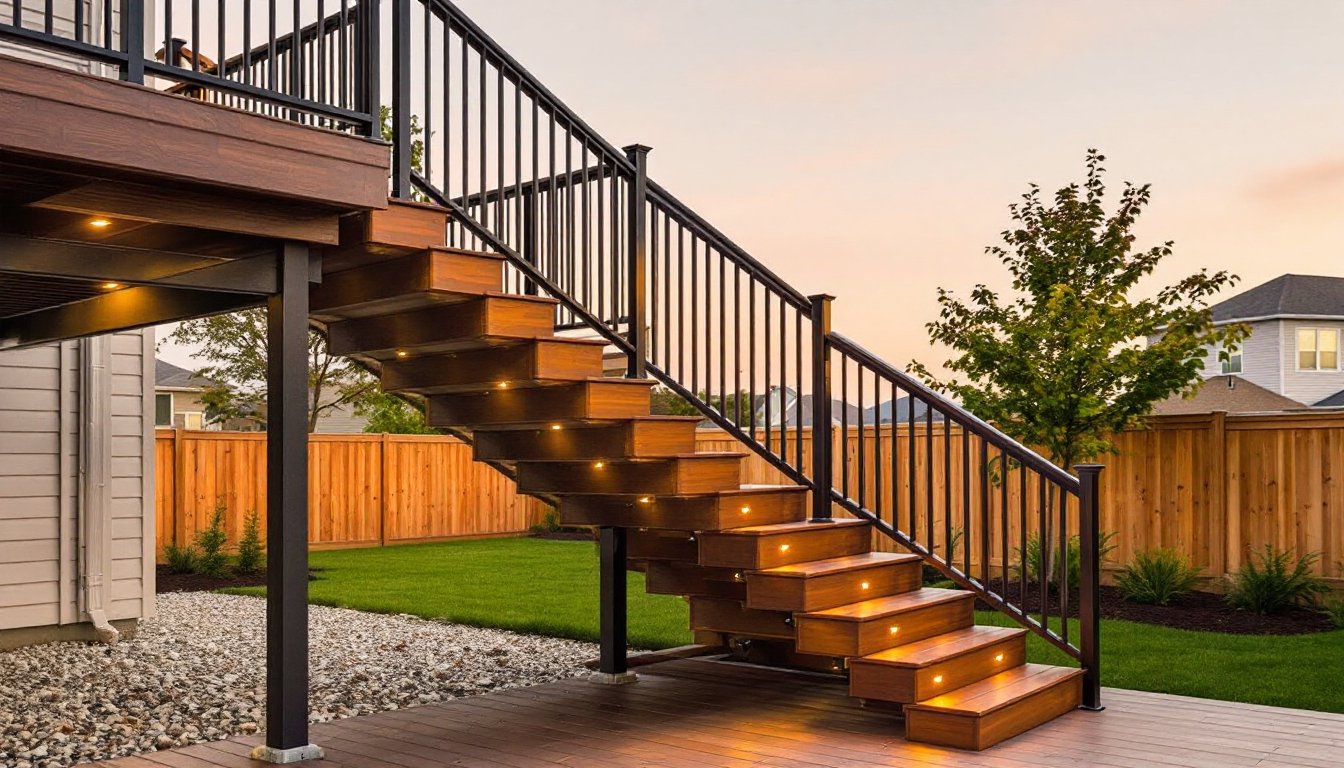
Modern Floating and Open Riser Stairs
Floating stairs, where treads appear to hover without visible stringers, are the design move for contemporary decks. Open risers (no vertical boards between treads) keep sightlines clean and let light pass through.
Two main methods: mono-stringer or hidden steel brackets. A mono-stringer uses a single thick beam (typically a 6×12 timber or steel C-channel) running down the center, with treads cantilevered on both sides. Steel brackets mount to the deck rim joist and are recessed into or bolted beneath each tread.
Either approach requires engineered plans and a permit in most jurisdictions. The IRC restricts open risers to a 4-inch sphere rule: nothing larger than a 4-inch ball should pass through, which means treads must overhang or blocking must fill gaps if young kids are around.
Tread material upgrades here. 2-inch-thick hardwood (ipe, cumaru, or thermally modified ash) provides mass and rigidity for cantilevered spans. Steel plate treads with diamond tread or powder coat work for industrial aesthetics but require welding and custom fabrication.
Safety note: Open risers can feel precarious to anyone with a fear of heights or limited mobility. If the deck is elevated above 8 feet, consider closed risers or a hybrid approach with the bottom half open, top half enclosed. Handrails are non-negotiable, 34–38 inches measured vertically from the tread nosing.
DIYers with woodworking skills and a solid tool kit can tackle basic mono-stringer builds, but steel brackets and welding typically require a fabricator.
Creative Railing and Lighting Ideas
Railings and lighting turn functional stairs into finished architecture.
Railing styles:
- Cable rail (horizontal stainless steel cables) keeps views open and suits modern or coastal decks. Tension must be checked annually: cables stretch.
- Glass panels (tempered, ½-inch thick) maximize views but show fingerprints and require a sturdy frame system, aluminum or steel posts on 4–6 foot centers.
- Vertical metal balusters (aluminum or powder-coated steel) offer a clean, low-maintenance look. Space them no more than 4 inches apart (IRC sphere rule).
- Traditional wood balusters (turned or square 2×2s) pair well with craftsman or farmhouse styles. Prime all six sides before install to prevent rot.
Mix materials intentionally: composite top rail on aluminum balusters, or wood posts with cable infill. Avoid mixing too many finishes, black metal, stainless cables, and white vinyl together rarely works.
Lighting upgrades safety and ambiance. Install riser lights (low-voltage LED strips or individual puck lights recessed into each riser face) to define edges at night. Tread lights mount flush in the tread surface but can collect debris. Post cap lights on railing newels provide overhead glow and mark entry points.
All outdoor lighting should be 12V DC low-voltage or 120V AC on a GFCI-protected circuit per NEC standards. Transformer sizing depends on total wattage, add up all fixtures and choose a transformer rated 20% above the total load. Use direct-burial UF-B cable (14 or 12 AWG) for underground runs from the house.
For color-changing effects, RGB LED strips with a weatherproof controller add flexibility for parties or holidays. Mount drivers and controllers inside a weatherproof junction box and test all connections before closing up. Decorating elements like artistic wall features can inspire complementary stair treatments, especially where stairs pass indoor spaces with sightlines.
Conclusion
Deck stairs set the functional and visual tone for the entire outdoor space. Whether opting for a straightforward run, a dramatic cascading entry, or a modern floating design, the principles stay the same: build to code, size stringers correctly, choose durable materials, and don’t skip the prep work.
Invest time in layout and footing placement. The difference between stairs that last 10 years and stairs that last 30 comes down to drainage, material contact with soil, and structural support. And if the project involves steel, complex angles, or anything over 10 feet in total rise, bring in a pro or structural engineer for the design phase. Good stairs are invisible in use, they just work.


